The sinus node is located in the subepicardial tissue on the lateral wall of the right atrium near the junction of the SVC and the right atrium in the sulcus terminalis.
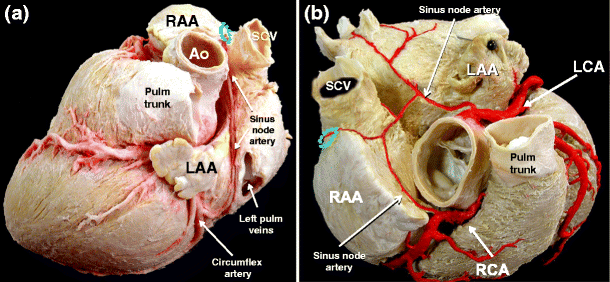
SA Node indicated by blue circle
The SA node is the normal pacemaker of the heart.
The SA) node possesses spontaneous depolarization (automaticity).
This impulse spreads rapidly through the atria.
The electrical impulse is usually at a frequency of 60–100 bpm.
Spread of the depolarization wave through the right and left atria induces contraction of these chambers.
The depolarization waves converge at the atrioventricular node which is normally the only conduction pathway between the atria and ventricles.
It is on average 10 to 20 mm in length. Its vascular supply is from the SA nodal artery, a branch of the right coronary artery (~60% of people) or the left circumflex artery (~40% of people).
It has extensive input from both the parasympathetic and sympathetic nervous systems via the vagus nerve and the sympathetic chain, respectively. The parasympathetic effects on the sinus node, via acetylcholine, are negative chronotropy, prolongation of intranodal conduction time, and increased refractoriness. The concentration of acetylcholine in the atria, and the SA node in particular, is significantly greater than that in the ventricles, and there is tonic parasympathetic stimulation of the SA node. Sympathetic effects include positive chronotropy via an increase in the rate of sinus node discharge and decreased refractoriness.